



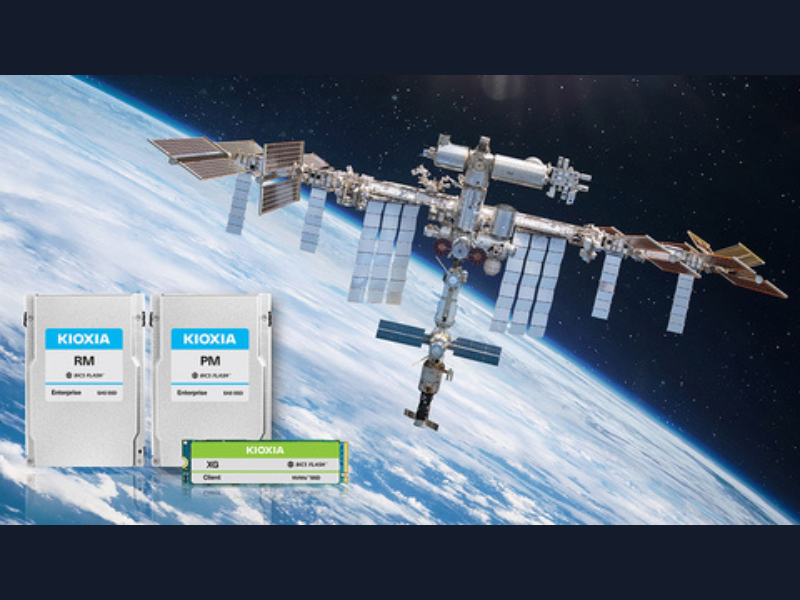
KIOXIA SSDs took flight with the launch of the NG-20 mission rocket yesterday, which is delivering an updated HPE Spaceborne Computer-2, based on HPE EdgeLine and ProLiant servers from Hewlett Packard Enterprise (HPE), to the International Space Station (ISS). KIOXIA SSDs provide robust flash storage in HPE Spaceborne Computer-2 to conduct scientific experiments aboard the space station.
HPE Spaceborne Computer-2, based on commercial off-the-shelf technology, provides edge computing and AI capabilities on board the research outpost as part of a greater mission to significantly advance computing power in space and reduce dependency on communications as space exploration continues to expand. Designed to perform various high-performance computing (HPC) workloads in space, including real-time image processing, deep learning, and scientific simulations, HPE Spaceborne Computer-2 can be used to compute several experiment types including healthcare, natural disaster recovery, 3D printing, 5G, AI, and more.
As the data storage provider for the HPE Spaceborne Computer-2, Kioxia has provided flash memory-based SSDs, including KIOXIA RM Series value SAS, PM Series enterprise SAS and XG Series NVMeTM SSDs, to enable these advancements. In addition to eight 1,024 gigabytes (GB) NVMe and four 960 GB value SAS SSDs, each of the four enterprise SAS SSDs provided by Kioxia have a capacity of 30.72 terabytes (TB) for a total of more than 130 TB – the most data storage to travel to the space station on a single mission. [1]
Flash memory-based SSDs are better-suited than traditional hard disk drive storage to withstand outer space’s power, performance and reliability requirements, as they have no moving parts and provide faster performance. SSD health will be monitored throughout the mission, with daily log files transmitted from the ISS. Kioxia will track and analyze this health data to better understand how flash memory storage operates in the harsh space environment.
Kioxia has been collaborating with HPE to create best-in-class storage solutions for years, and the company’s products enable a broad range of HPE solutions and services, from mobile to the cloud to the enterprise.