





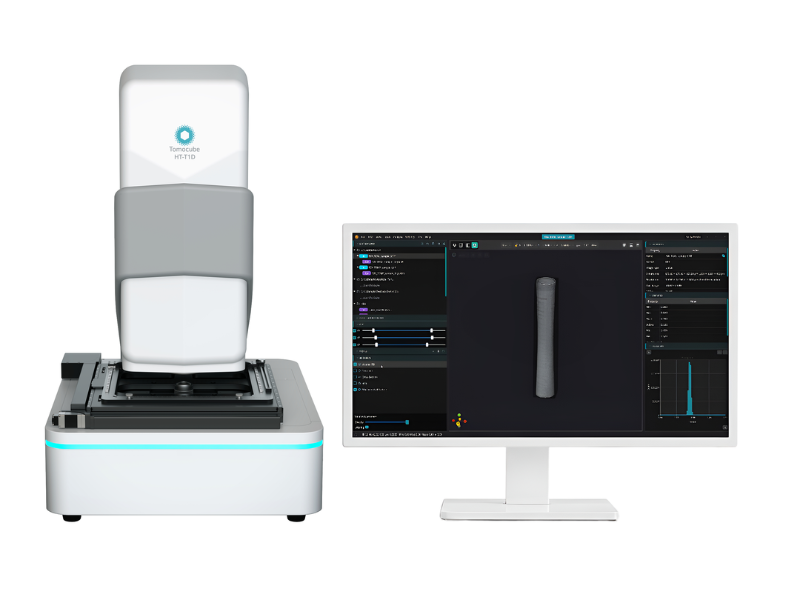
Tomocube, a 3D non-destructive inspection and metrology company, recently announced the launch of HT-T1 Desktop (HT-T1D), a desktop holotomography system for high-resolution 3D defect analysis of glass substrates used in next-generation semiconductor packaging.
HT-T1D is optimized for glass-substrate inspection and metrology workflows. When conventional in-line panel inspection tools, such as automated optical inspection (AOI) systems, flag a potential defect, HT-T1D takes the corresponding coordinates and reconstructs the interior of the glass substrate in three dimensions, resolving the location, morphology, and depth-wise characteristics of defects that surface inspection alone cannot reveal.
Glass core substrates and glass interposers are drawing growing attention as key enabling materials for AI accelerators, high-bandwidth memory (HBM), and other advanced packaging applications. As these substrates move toward mass production, however, manufacturers face mounting challenges in identifying the root causes of micro-defects introduced during complex process steps such as laser drilling, etching, metallization, and singulation. A single critical defect can scrap an entire unit. As a result, the ability to quickly turn inspection data into process improvements has become critical to production-line stability.
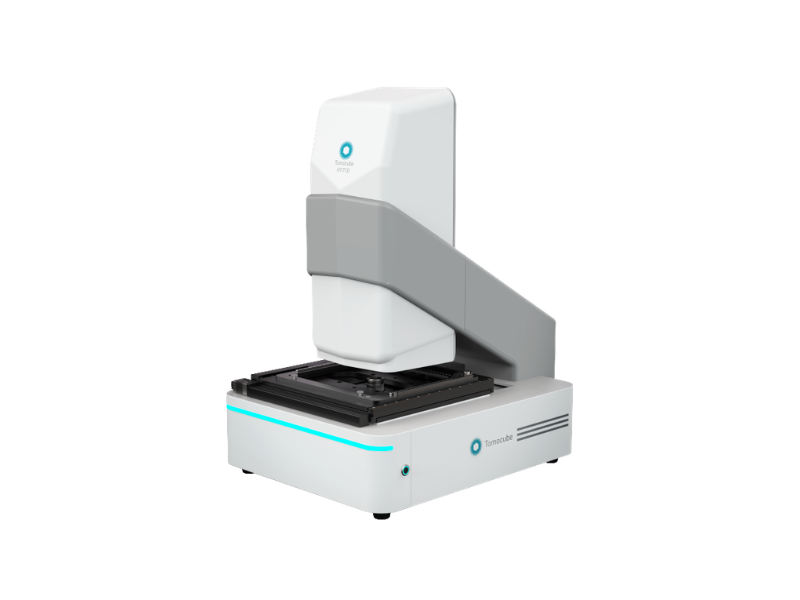
HT-T1D applies Tomocube’s visible-light holotomography to visualize the three-dimensional refractive-index distribution inside glass with a refractive-index sensitivity of 10⁻⁴. Because the measurement is non-destructive, the same location can be measured repeatedly across successive process stages, allowing users to track when and how a defect forms, propagates, or enlarges. The system is expected to shorten defect-analysis cycles that have traditionally depended on destructive failure analysis, reducing analysis time from days or weeks to minutes in applicable workflows and supporting earlier intervention ahead of high-cost downstream steps.
Alongside the hardware, Tomocube also introduced TomoAnalysis MI (TAMI), a dedicated 3D analysis software platform for metrology and inspection. TAMI quantitatively analyzes 3D refractive-index volume data and generates structured reports for engineering review. It also processes data from HT-T1M, Tomocube’s planned in-line module for deployment through system integration partners, in the same format — providing a unified workflow from R&D investigation through production-line review.
“Glass substrates are emerging as a critical material for next-generation semiconductor packaging, but true competitiveness in mass-production will depend on how quickly manufacturers can understand defects and translate that understanding into process improvements,” said YongKeun Park, Chief Executive Officer of Tomocube. “HT-T1D goes beyond defect detection, helping customers identify root causes and refine process conditions. We believe it will become an essential metrology platform for accelerating yield learning in glass-substrate manufacturing.”

He added, “The same platform can also address glass photonic integrated substrates for co-packaged optics (CPO), where the refractive index itself directly affects device performance. This expands its applicability beyond defect analysis to areas that require functional metrology.”
With the launch of HT-T1D, Tomocube will engage glass-substrate manufacturers, advanced-packaging companies, and system integration partners to support 3D defect analysis, process review, and yield-learning workflows for glass-substrate manufacturing. The company will also continue to expand its glass-substrate inspection and metrology portfolio, including future in-line deployment through system integration partners, as it addresses the growing demand for defect-analysis and yield-learning solutions in advanced semiconductor packaging.
For more similar news, check links below:
Nexa3D launches Nexa AI – an Innovative Software Platform for its Industrial 3D Printer
xTool Debuts O1 Omni All-in-One Printer for Virtually Any Material
XtraMaker Launches 5-in-1 Desktop DTF Printer