



In an era where personal privacy has all but vanished, the concepts of safety and security feel increasingly out of reach. This erosion isn’t solely the fault of social media; rather, it is a byproduct of how modern technology is systematically exploited. While modern technology is easily exploited online, it can also be harnessed to fortify our immediate surroundings. This is exactly where the strategic importance of smart locks comes into play, shifting home defense from a vulnerable, static piece of hardware into a dynamic, manageable system. By eliminating easily compromised physical keys, these devices allow you to grant secure, temporary digital access to guests or service workers remotely while tracking exactly who enters your home in real time.
The Mechanics of Smart Locks
At its core, a smart lock is a digital deadbolt that bridges the gap between physical security and wireless technology. Unlike a traditional tumbler (a conventional, purely mechanical door lock, specifically a pin tumbler lock that requires a physical metal key to open) that relies on a jagged piece of metal, these electromechanical devices trigger their locking mechanisms through encrypted electronic signals. By leveraging protocols like Bluetooth, Wi-Fi, or Z-Wave, they verify a user’s identity through a digital “handshake” before granting access.
Why the Shift Away from Traditional Keys?
The move toward smart entry systems isn’t just about high-tech vanity, it’s about solving the logistical challenges of modern life. The primary driver here is granular access control. Traditional keys are rigid; once you hand one out, you lose oversight of when it’s used. Smart access control systems modify this paradigm, allowing property owners to authorize specific users and schedule precise entry windows.
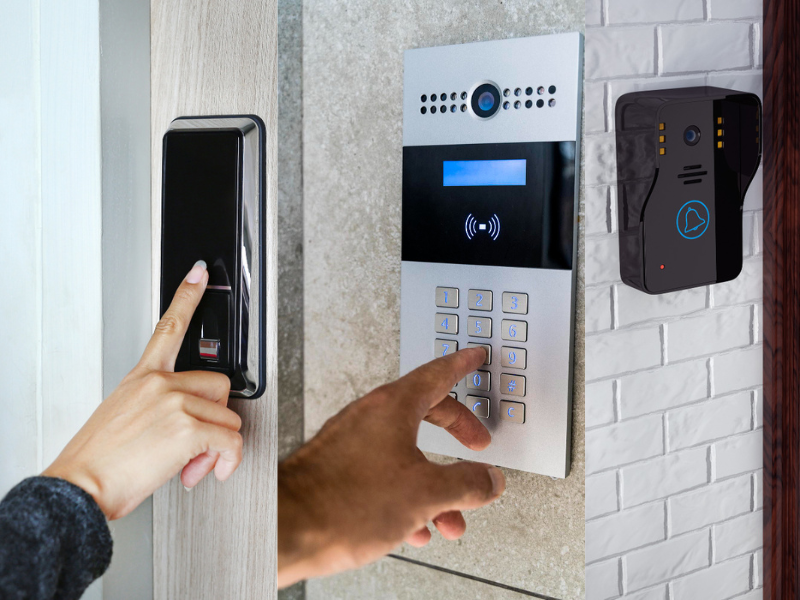
This shift is less of a luxury and more of a practical adaptation to a world that revolves around smartphones. By replacing the physical key with biometrics (fingerprints), personalized PIN codes, RFID tags, or mobile apps, these systems eliminate the “friction” of lost keys and unauthorized copies. Ultimately, they offer a level of oversight and authority over one’s personal space that mechanical locks simply cannot match.
The Power of Fingerprint Recognition
Fingerprints remain one of the most reliable forms of identification because they are fundamentally unique. The mathematical probability of two individuals, even identical twins sharing the same ridge patterns is essentially zero, making biometrics a cornerstone of modern security.
Unlike a physical key or a memorized PIN, your fingerprint is an “irreplaceable key.” It can’t be left behind at a coffee shop, and it’s incredibly difficult to duplicate or misplace. This ensures that access is tied strictly to the individual, not just to whoever happens to be holding a specific object or code. Furthermore, current scanning technology has moved far beyond simple images. Modern capacitive and ultrasonic sensors create high-resolution, 3D maps of skin ridges, allowing the system to easily distinguish between a living finger and a fraudulent 2D replica.
Integrating Smart Locks with Smartphones
For many homeowners around the world, transitioning to a digital entry system is becoming a seamless part of urban living. There is a common misconception that switching to a smart lock requires a massive renovation or replacing your entire door. In reality, most modern systems are designed to fit onto existing door structures with minimal fuss.
By syncing a smart lock with a smartphone, you effectively turn your mobile device into a master command center. Through a dedicated app, you can lock or unlock your home remotely, receive real-time alerts when someone enters, and manage digital permissions for guests or service providers. This evolution allows you to modernize your home security safely and comfortably, streamlining your daily routine without the need for complex hardware overhauls.
The cost of smart locks varies significantly across global markets, influenced by local labor rates and the complexity of existing door hardware. Here is a global perspective on affordability in 2026:
Are smart locks affordable?
Global Price Tiers (Hardware Only)
| Tier | North America (USD) | Europe (EUR) | Australia (AUD) |
| Budget | $80 – $150 | €75 – €140 | $120 – $230 |
| Mid-Range | $150 – $300 | €140 – €280 | $230 – $450 |
| Premium | $300 – $600+ | €280 – €550+ | $450 – $900+ |
Regional Market Characteristics
- North America: The market is dominated by deadbolt replacements (Schlage, August, Yale). Affordable options like the Ultraloq U-Bolt often retail for around $120. High-end models featuring Apple Home Key (using NFC) usually sit above $250.
- Europe: Because many European doors use multi-point locking systems or Euro-cylinders, “retrofit” locks like Nuki or Danalock are popular. These are slightly pricier (averaging €200) but save money because they don’t require changing the entire handle or lock mechanism.
- Asia-Pacific: This region sees the most aggressive pricing due to local manufacturing. In markets like Singapore or Australia, integrated “handle-style” locks are common, with mid-range biometric handles starting at roughly $250 AUD.
The “Hidden” Cost: Professional Installation
While many smart locks are marketed as DIY-friendly, professional installation costs vary wildly by region:
- USA/Canada: A locksmith typically charges $100 – $250 for labor.
- UK/Europe: Rates are similar, often ranging from £80 – £150.
- Australia: Professional installation can range from $150 – $300 AUD, especially for high-security mortise locks.
Value Beyond the Price Tag
In Western markets, the affordability of a smart lock is often weighed against insurance premiums. Some providers offer discounts for installing “smart” security systems that include audit trails and tamper alerts, potentially offsetting the initial hardware cost over 2–3 years.
Ultimately, smart locks represent a shift from traditional physical barriers to intelligent, invisible access management. By integrating precision technologies like Ultra Wideband and unified standards like Matter, they are removing the friction of daily entry while offering a level of oversight through real-time logs and temporary digital keys that a metal key simply cannot provide. As these devices move toward proactive, AI-driven security, the door becomes more than just a gateway; it becomes a responsive guardian that balances convenience with sophisticated, personalized protection.
Article by Siddharth Janardhan
.
For more information on Smart Locks, please check-
TCL Unveils D2 Pro Palm Vein Smart Lock
Aqara announces Global Availability of Smart Lock U200