

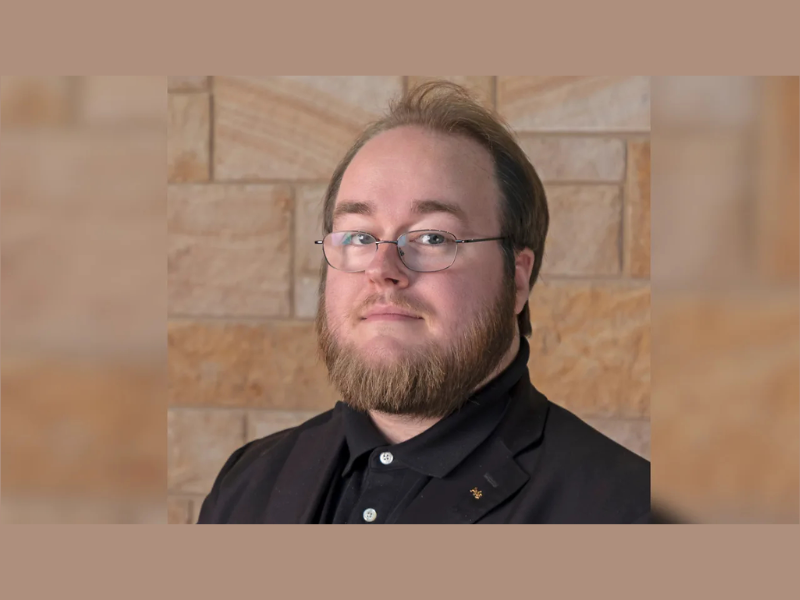
The Stowers Institute for Medical Research has appointed Charles McAnany, Ph.D., as its second AI Fellow, continuing the Institute’s investment in artificial intelligence as a powerful tool for advancing biological discovery.
McAnany’s research centers on understanding the language of DNA — the regulatory instructions that help determine when, where, and how genes are used. Since joining the Stowers Institute in 2019, he has worked in the lab of Investigator Julia Zeitlinger, Ph.D., who leads the Institute’s AI Initiative, which launched in 2024. His work applies machine learning to genomic data to uncover the rules that shape gene regulation.
A central challenge in using AI to study the genome is that even highly accurate models can be difficult to interpret. McAnany has developed approaches to visualize what these models learn, helping reveal patterns in DNA that influence gene activity and making AI more useful for biologists.
“There has never been a more exciting or promising time for biologists to ask the kinds of questions that can truly make an impact,” said Institute President and Chief Scientific Officer Alejandro Sánchez Alvarado, Ph.D. “The amount of data we have available today — and the speed at which we can decipher it — was truly unthinkable even just a few years ago.”
As an AI Fellow, McAnany plans to expand access to deep learning approaches across the Stowers research community, helping Investigators apply advanced computational methods to large and complex datasets from genomics, structural biology, and other areas of research.
“Charles has a rare ability to bridge computational innovation with fundamental biological questions,” said Zeitlinger. “He not only develops powerful AI tools but also helps make them understandable and accessible to other scientists. That combination of creativity, rigor, and collaboration makes him an incredible asset to the Institute and the scientific community at large.”
McAnany joins the Institute’s first AI Fellow, Sumner Magruder, Ph.D., who was appointed in fall 2025. The growing program is designed to support early-career scientists pursuing bold ideas at the intersection of AI and fundamental biological research.
“You must always start with a question; everything else flows from that,” said McAnany. “My goal is to build tools that help scientists ask better questions of their data and make those tools accessible enough for others to use.”
The emphasis on making AI not only powerful, but also usable, reflects a broader goal of the Institute’s AI Initiative: to connect computational innovation directly to the questions driving biological discovery.
“Charles brings both curiosity and technical depth to some of the most difficult questions regarding DNA and what makes us who we are,” said Scientific Director Kausik Si, Ph.D. “What goes wrong when disease happens? His ability to look at genomic information through the lens of machine learning is uncovering patterns and principles that, for years, have remained hidden in extremely large, extremely complex amounts of data.”
The AI Fellow program reflects the Institute’s mission to improve human health by generating new knowledge in research that spans neuroscience, infertility, cancer, regeneration, infectious disease and more.
“AI is transforming how we approach science, opening new paths to tackle not just a single question, but many at once,” Sánchez Alvarado said. “By deepening our investment in the AI Initiative, we’re deliberately weaving computation into experimentation, turning complex datasets into actionable insight. This is allowing us to confront some of the most difficult challenges in the life sciences that have for too long been beyond the reach of traditional tools.”
Read Similar News:
SpartanNash Announces New IT Leadership with CIO and CISO Appointments
BCN Expands Nationwide Sales Coverage with Appointment of Two New Sales Directors
Jetcraft reinforces North American presence with new Sales Director appointments