





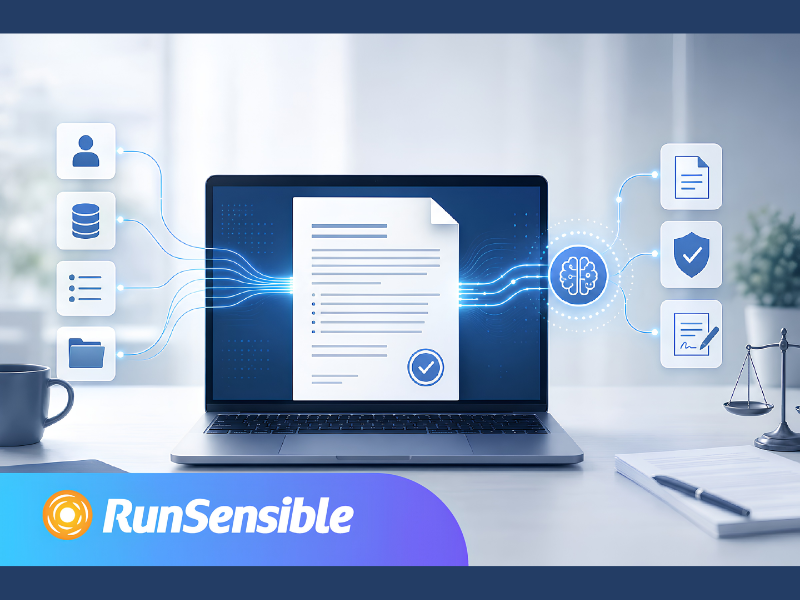
RunSensible, a legal practice management platform for law firms, recently announced a broader approach to legal document creation that combines structured document automation through RunSensible Template with AI-assisted drafting through RunSensible Draft.
Legal documents often require two very different types of work. Some information is structured and repeatable, including client names, matter details, dates, addresses, party information, standard clauses, and other data already collected by the firm. Other parts of a legal document require drafting, review, rewriting, refinement, and professional judgment.
RunSensible addresses these needs with two complementary tools designed around the way legal professionals already create and manage documents.
RunSensible Template allows law firms to turn their existing Microsoft Word documents into automated templates without coding. Client and matter information can be used to populate documents automatically, while data collected through client intake can flow into document creation, helping reduce duplicate data entry and repetitive administrative work.
Instead of requiring firms to rebuild their established documents in a separate proprietary editor, RunSensible Template is designed to work with the Word templates firms already use. Documents can be generated in Word or PDF format for contracts, court forms, letters, and other legal documents.
RunSensible Draft brings AI-assisted drafting directly into Microsoft Word. Legal professionals can use it to create, review, revise, and refine written content while continuing to work in the familiar Word environment.
“Legal document automation should not mean asking AI to generate everything from scratch,” said Kaven Hendiz, CEO of RunSensible. “Some parts of a legal document are structured, predictable, and based on information the firm already has. Other parts require flexible drafting, review, and judgment. Our goal is to give law firms the right technology for each part of the document creation process.”
The approach reflects a broader shift in legal technology. AI-assisted drafting has rapidly become a major area of investment across the industry, but structured document automation continues to play an important role for firms that need consistency, repeatability, and control over standard legal documents.
RunSensible’s approach is based on the idea that automation and AI serve different purposes.

Structured automation can help firms standardize repeatable documents and reuse client and matter information that has already been collected. AI-assisted drafting can support the portions of legal work that require new language, revisions, review, or refinement.
By offering both capabilities, RunSensible aims to help firms reduce repetitive document preparation without forcing lawyers to abandon their existing templates, processes, or Microsoft Word workflows.
The result is a more practical model for legal document work: automate the information that is known and repeatable, while using AI assistance where additional writing and refinement are needed.
For law firms, this can mean less time re-entering the same information, greater consistency across documents, and a more efficient way to create and refine legal content.
Law firms can learn more about RunSensible Template and RunSensible Draft at RunSensible official website.
For more similar info, check out the links below:
Oracle Introduces New Fusion Agentic Applications and AI Agents for Talent Management
Takeads Launches Zyntent: An AI Revenue Layer That Captures Shoppers While They Decide
CORe Introduces IrukaDark, an AI Assistant for Everyday Desktop Tasks